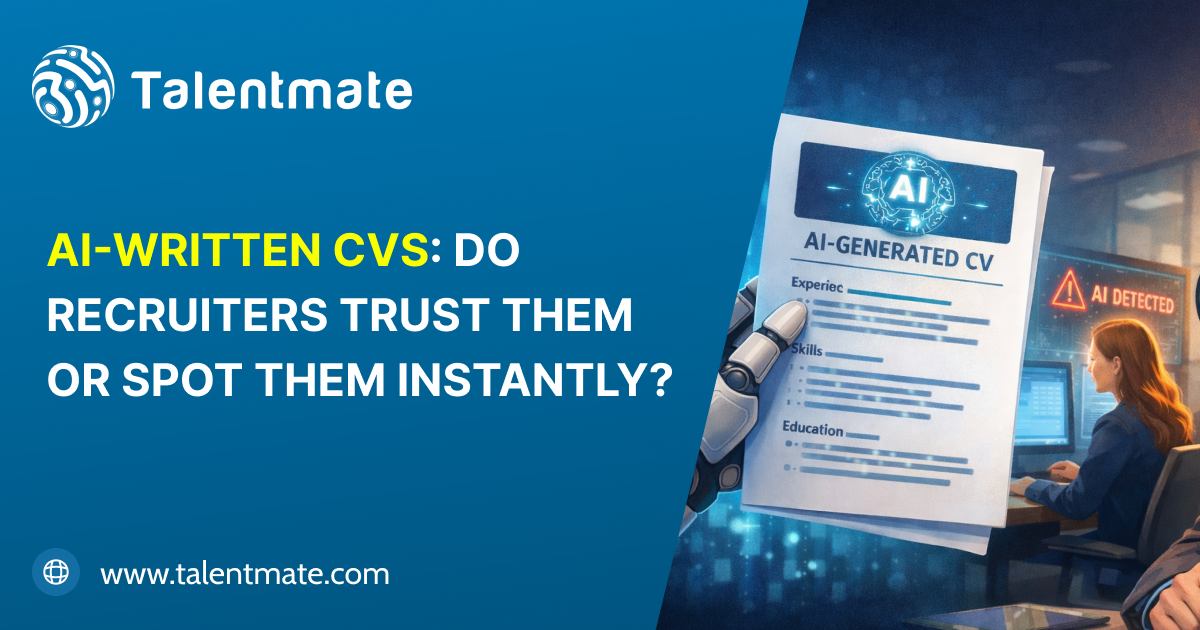
Do recruiters trust AI-written CVs, or do they simply ignore them? In today’s AI-driven job market, this question has become one of the most common and confusing concerns for job seekers. As AI tools become increasingly accessible, candidates are using them to write, edit, and optimize their CVs faster than ever before. In fact, it has become possible to generate an entire CV simply by providing a job description and basic personal details.
At the same time, many recruiters have shared their opinions on public platforms, advising candidates to be careful when using AI for their CVs. They explain that while AI can improve structure, grammar, and clarity, it can also make CVs sound generic or impersonal. Recruiters are not actually against AI; in fact, it can support their efforts to hire top talent more efficiently, but they’re cautious of CVs that feel copied, exaggerated, or disconnected from the real person behind them.
This situation has created confusion among job seekers. Should AI be used or avoided? The answer lies in understanding what makes recruiters lose interest in your CVs.
Do Recruiters Review CVs Manually After ATS Screening?
Yes, in most cases, recruiters do manually review CVs after the initial ATS (Applicant Tracking System) screening. ATS software is mainly used to filter applications based on keywords, job titles, and basic requirements. It helps recruiters manage large numbers of applications, but it does not make final decisions.
Once a CV passes the ATS, a recruiter usually reviews it personally to decide whether the candidate should move forward. At this stage, recruiters look for clarity, relevance, and consistency. They assess whether the experience truly matches the role and whether the CV feels realistic and credible.
This is where overly generic or obviously AI-written CVs can struggle. Even if they pass the ATS, they may fail to impress a human reviewer.
Can Recruiters Actually Spot AI-Written CVs?
In many cases, yes, but not always. Recruiters review a large number of CVs every day, especially in highly competitive markets like the UAE. Because of this experience, they become very good at noticing patterns.
AI-written CVs often use polished but vague language, repeated buzzwords, and broad claims without specific examples. Another common sign is a lack of personal detail. When every bullet point sounds equally strong and formal, the CV feels unnatural. Recruiters may not say, “This is written by AI,” but they often sense that the CV does not reflect a real person’s voice.
However, a well-edited, AI-assisted CV is much harder to detect. When candidates use AI as a drafting tool, and then refine the language, clarify achievements, and edit it with their own voice, the result is often indistinguishable from a traditionally written resume.
Do recruiters trust AI-written CVs?
Trust isn’t really about how the CV was written; it’s about what it represents. Recruiters care about accuracy, clarity, and relevance. If you use AI to create your CV and it genuinely reflects your real experience, with AI simply helping to organize or polish the content, there is generally no issue. Many recruiters understand that candidates use tools to improve their presentation.
The problem begins when AI is used irresponsibly.
Exaggerating responsibilities, inflating job titles, inserting skills a candidate doesn’t actually possess, copying job description keywords purely to “game” ATS systems, or submitting an AI-generated CV without carefully reviewing it; these are the real red flags. AI tools can misinterpret information, generate incorrect details, or create overly generic statements. When candidates fail to edit and verify the content, errors and inconsistencies become obvious to recruiters, damaging credibility and reducing the chances of being shortlisted. Even if a candidate makes it to the interview stage, those gaps become apparent during deeper discussions. And that’s when trust is truly lost.
In the end, AI is just a tool. Used responsibly, it enhances clarity and professionalism. Used carelessly, it undermines credibility.
How candidates should use AI wisely
For job seekers, the takeaway is simple: AI should be a tool, not a mask. The best approach is to:
Use AI to draft or refine, not fabricate
Add measurable results and specific examples.
Edit manually so the language sounds like you.
Be prepared to explain everything on your CV.
If you can confidently talk through every line, recruiters are unlikely to care how it was written.
Frequently Asked Questions
1. Do recruiters reject my CV if they suspect AI was used?
No. Recruiters care more about relevance and accuracy than how the CV was written.
If AI is used to assist and the content is truthful, clear, and matches your real experience, it’s not a problem.
2. Can ATS detect AI-written CVs?
No. Standard ATS systems are designed to scan for keywords, skills, and proper formatting to see if your CV matches the job description; they do not detect whether AI was used. However, once your CV passes the ATS, a human recruiter may notice if the content sounds too generic, repetitive, or unnatural.
3. What is the safest way to use AI for CV writing?
The safest method is a three-step approach:
Write your raw experience in your own words.
Use AI to refine clarity, grammar, and structure.
Edit again to ensure the final version sounds natural and authentic.
If you can speak confidently about everything on the page, you’re using AI responsibly.
4. Is it better to avoid AI completely?
No, you don’t need to avoid AI completely. It can help improve grammar, clarity, and organization, and make your CV look more professional. It can also help you match your CV to job requirements. Just make sure you review and personalize everything before submitting it.
5. Can AI help improve my chances of passing ATS?
Yes, if you use it properly.
AI can help you spot important keywords in a job description and suggest natural ways to include them in your CV. This can improve clarity and help your CV pass Applicant Tracking Systems (ATS). Just make sure everything you include is true. Don’t copy and paste the job description word for word, that can make your CV look fake or untrustworthy.
Use AI as a support tool: review the suggestions, edit them carefully, and tailor everything to match your real skills and experience.
6. How do I make my AI CV less generic?
Add:
Specific metrics (e.g., “Increased revenue by 30%”)
Clear details about the projects you handled and your responsibilities
The tools and technologies you actually used
7. How long should a CV be?
Entry-level: 1 page
Mid-level: 1 to 2 pages
Senior roles: 2 pages max
The Bottom Line
Recruiters don’t automatically reject AI-written CVs, but they quickly judge authenticity and relevance. They care more about accuracy, clarity, and measurable achievements than how the CV was created. AI can improve structure and help with keywords, but overly generic or exaggerated content can reduce credibility. The safest approach is to use AI as a tool to refine your real experience, then edit it so it sounds natural and truthful. In the end, recruiters trust what feels genuine and defensible.